Crucial 512GB Micron 2400 internal SSD M.2 2230 - PCIe 4.0 (NVMe) MTFDKBK512QFM-1BD1AABYYR
Regular price
Dhs. 276.00
Sold Out
Tax included.
SKU: MTFDKBK512QFM-1BD1AABYYR
Adding product to your cart
512GB compact PCIe Gen4 client NVMe SSD
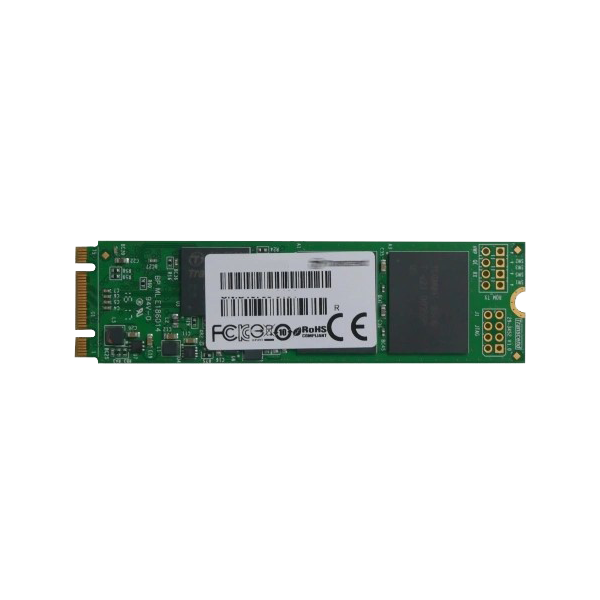
Micron 2400 512GB M.2 2230 MTFDKBK512QFM-1BD1AABYYR Internal SSD
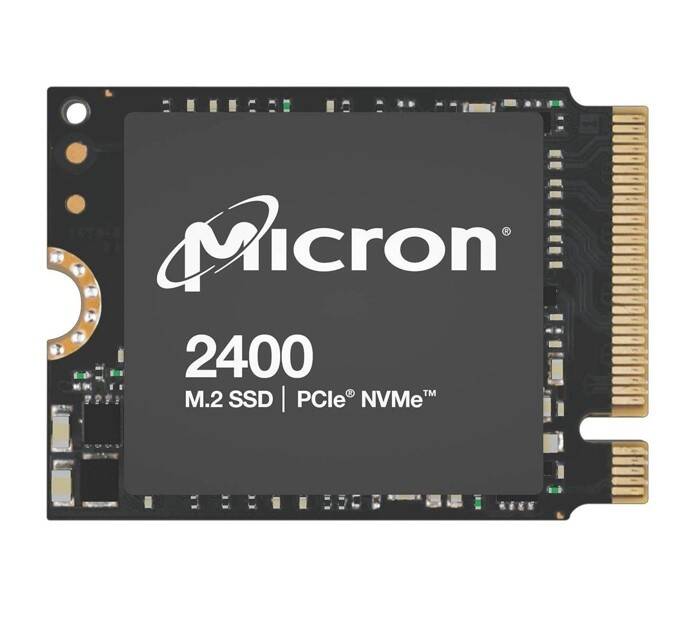
The Micron 2400 512GB M.2 2230 MTFDKBK512QFM-1BD1AABYYR is a single-sided M.2 2230 client SSD built with Micron 176-layer QLC NAND. It uses PCIe Gen4 and NVMe 1.4 and is rated up to 4,200MB/s sequential read, 1,800MB/s sequential write, 400K/400K random read/write IOPS and 150TBW endurance.
- 512GB
- M.2 2230
- PCIe Gen4
- 4,200/1,800MB/s
- 400K/400K IOPS
- 150TBW
| Capacity |
512GB |
| Form factor |
M.2 2230, single-sided |
| Sequential performance |
Up to 4,200/1,800MB/s |
| Endurance |
150TBW |
Compact Gen4 storage for qualified thin-and-light systems
The Micron 2400 512GB M.2 2230 MTFDKBK512QFM-1BD1AABYYR places 512GB of client storage in the compact 22 × 30mm M.2 form factor. Micron lists hardware-based AES 256-bit encryption, RAIN, SMART, TCG Opal 2.0, TCG Pyrite 2.0, sanitize support, secure boot and Micron Storage Executive. Confirm the host accepts a 2230-length NVMe module before purchase.
M.2 2230 footprint
The compact single-sided 22 × 30mm design is intended for qualified systems that specifically accept M.2 2230 NVMe storage.
Up to 4,200MB/s read
Micron rates the 512GB profile up to 4,200MB/s sequential read under its stated test conditions.
Up to 1,800MB/s write
The capacity-specific sequential write rating is up to 1,800MB/s; actual results depend on the host and workload.
400K/400K random IOPS
The 512GB model is rated up to 400K random-read and 400K random-write IOPS.
150TBW endurance
Micron publishes 150TBW endurance and a two-million-hour MTTF population statistic for the 512GB capacity.
Client security features
Hardware AES 256-bit encryption, TCG Opal 2.0, TCG Pyrite 2.0 and secure-management features are listed for the family.
Who is the Micron 2400 512GB M.2 2230 MTFDKBK512QFM-1BD1AABYYR best for?
A strong choice for
- Qualified laptops and compact PCs with an M.2 2230 NVMe slot
- Replacing or expanding client storage where 512GB is suitable
- Everyday productivity and general client workloads
- Systems that can use a single-sided PCIe Gen4 module
- Deployments that value Micron management and security features
Consider another model if you need
- Your device accepts only M.2 2242 or 2280 modules
- Your host supports SATA M.2 but not NVMe
- You need endurance above 150TBW
- You require a larger capacity or a data-centre SSD
Key specifications
| Part number |
MTFDKBK512QFM-1BD1AABYYR |
| Series |
Micron 2400 |
| Capacity |
512GB |
| NAND |
Micron 176-layer QLC NAND |
| Form factor |
M.2 2230, single-sided |
| Interface |
PCIe Gen4; NVMe 1.4 |
| Sequential read/write |
Up to 4,200/1,800MB/s |
| Random read/write |
Up to 400K/400K IOPS |
| Endurance |
150TBW |
| MTTF |
2 million hours |
| Encryption |
Hardware-based AES 256-bit |
| Source warranty |
Three years |
Full technical specifications
Identity, capacity and interface
| Manufacturer |
Micron |
| Product series |
Micron 2400 |
| Part number |
MTFDKBK512QFM-1BD1AABYYR |
| Capacity |
512GB |
| Drive type |
Internal client solid-state drive |
| Form factor |
M.2 2230 |
| Physical size |
22 × 30mm |
| Module layout |
Single-sided |
| Interface |
PCIe Gen4 |
| Protocol |
NVMe 1.4 |
| NAND |
Micron 176-layer QLC NAND |
| Target category |
PCIe Gen4 PCs and notebooks |
Performance, power and endurance
| Sequential read |
Up to 4,200MB/s |
| Sequential write |
Up to 1,800MB/s |
| Random read |
Up to 400K IOPS |
| Random write |
Up to 400K IOPS |
| Endurance |
150TBW |
| MTTF |
2 million hours; population statistic |
| Sleep / PS4 power |
Less than 2.5mW |
| Active idle power |
Less than 150mW |
| Performance note |
Published values are maximums measured under Micron test conditions |
Security, management and purchase checks
| Hardware encryption |
AES 256-bit |
| RAIN |
Supported |
| SMART |
Supported |
| TCG Opal |
Version 2.0 |
| TCG Pyrite |
Version 2.0 |
| Sanitize |
Supported |
| Secure boot |
Supported |
| Management |
Micron Storage Executive |
| Host requirement |
Compatible M.2 2230 PCIe NVMe slot |
| Generation note |
Can operate only within the host capabilities; confirm platform support |
| Warranty |
Three years, as supplied in the source listing |
| Capacity note |
Usable capacity is lower after formatting and system use |
| Backup note |
Keep independent backups of important data |
Frequently asked questions about the Micron 2400 512GB M.2 2230 MTFDKBK512QFM-1BD1AABYYR
What is the MTFDKBK512QFM-1BD1AABYYR?
It is a 512GB Micron 2400 client NVMe SSD in a single-sided M.2 2230 form factor.
How fast is the MTFDKBK512QFM-1BD1AABYYR?
Micron rates the 512GB model up to 4,200MB/s read, 1,800MB/s write and 400K/400K random IOPS.
What form factor does the MTFDKBK512QFM-1BD1AABYYR use?
It is an M.2 2230 module measuring 22 × 30mm.
Does the MTFDKBK512QFM-1BD1AABYYR use SATA?
No. It is a PCIe Gen4 NVMe 1.4 drive, not a SATA M.2 drive.
What NAND does the MTFDKBK512QFM-1BD1AABYYR use?
Micron identifies the 2400 family as 176-layer QLC NAND.
What endurance is specified for the MTFDKBK512QFM-1BD1AABYYR?
The 512GB profile is rated at 150TBW.
Does the MTFDKBK512QFM-1BD1AABYYR support encryption?
Micron lists hardware AES 256-bit encryption together with TCG Opal 2.0 and Pyrite 2.0 support.
Will the MTFDKBK512QFM-1BD1AABYYR fit every laptop?
No. The host must specifically accept an M.2 2230 PCIe NVMe module; check the device service documentation.
What power figures are published for the MTFDKBK512QFM-1BD1AABYYR?
Micron lists less than 2.5mW in sleep/PS4 and less than 150mW active idle for the family.
What warranty applies to the MTFDKBK512QFM-1BD1AABYYR?
The supplied listing states a three-year warranty; warranty coverage remains subject to the seller and manufacturer terms.
Important information:
- Confirm the host accepts an M.2 2230 PCIe NVMe module before ordering.
- Published performance is a maximum and varies with the host, workload, firmware and thermal conditions.
- Security-feature availability can depend on platform and management support.
- Maintain independent backups; an SSD is not a complete backup strategy.